Destroying Investor Value: Rejecting Exchange Ratio Deals
Marcus Laun
Published on May 29, 2025
Dear Market Participants, and specifically CEOs and Directors of Small Cap Public Companies,
Something deeply troubling is taking root in the small-cap and microcap markets, and if we don’t address it head-on, we risk allowing a wave of financial engineering to erode what little trust remains in this critical corner of the capital markets.
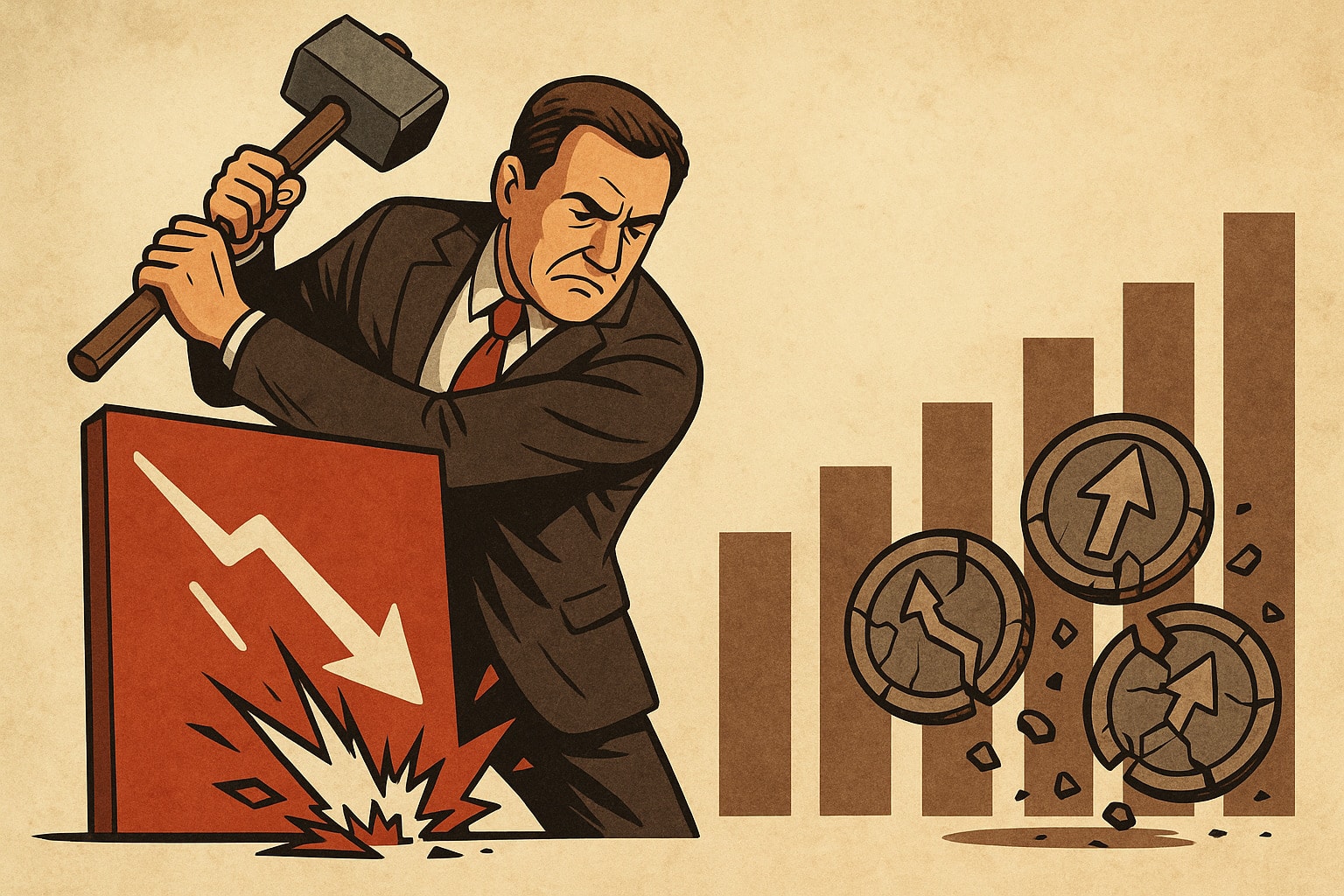
Over the past year, a dangerous new structure has emerged in the form of so-called "Exchange Ratio Deals." On the surface, these transactions may appear like ordinary capital raises, units consisting of common stock and warrants, but in practice, they function as shareholder dilution machines.
Let me explain how these work, why they’re so harmful, and why we, as fiduciaries of public capital, must take a stand against them.
What Are Exchange Ratio Deals?
Exchange Ratio Deals are being pitched to small-cap companies as “creative” financing solutions, but their mechanics are anything but innovative. These are unit offerings, typically structured with common stock bundled with multiple tranches of warrants that allow the warrant holders to massively multiply their ownership over time, often in unpredictable and devastating ways for existing shareholders.
In some cases, these structures contain anti-dilution provisions, reset clauses, or contingent conversion ratios that cause the effective share count to balloon, not by 10% or 20%, but by 20x, 30x, or even 40x.
Let me be very clear: any financing deal that has the potential to increase your fully diluted share count by 40x is not a financing deal. It’s a death spiral.
The real-world consequences of these deals are plain to see. Companies such as NWTN (NWTN), Greenlane Holdings (GNLN), and Damon Inc. (DMN) have all executed Exchange Ratio Deals, resulting in exploding share counts and share price declines of up to 99%.
Damon Inc. was an especially egregious case, where the exchange ratio deal completely decimated the company. The SEC eventually halted trading in DMN, but by then, the damage was done and the horses were already out of the barn. Damon has since been moved to the pink sheets. These are not isolated incidents, but a pattern, and it’s spreading.
Regulatory Approval ≠ Ethical Approval
It’s worth noting that these deals are being reviewed by the SEC and, in many cases, are sailing through shareholder votes. That fact alone should raise concern.
Just because something is legally permissible does not mean it is ethically permissible, or financially sound. The very structure of these transactions is designed to obscure the eventual scale of dilution. Often, these deals are approved under vague or misleading proxy language that doesn't clearly outline the full impact on shareholder value.
Worse, many investors, especially retail, do not fully grasp the compounding effect of these deal terms until it's too late. By the time the warrants are exercised and the conversion math is understood, the capital structure is shattered, and the stock is effectively worthless.
A Breach of Fiduciary Duty
To be a CEO or director of a public company is to accept a sacred responsibility: the stewardship of public capital. When people invest in our companies, they’re buying into a vision, and they’re trusting us to act in good faith.
Participating in or approving Exchange Ratio Deals is, in my view, a blatant violation of that trust. These transactions are designed to enrich the few at the expense of the many. They are not aligned with long-term value creation. They are a breach of fiduciary duty.
And make no mistake, this is not just about financial loss. It’s about credibility loss for the entire microcap space. Every time one of these deals goes through, it sends a signal to the broader market that small-cap companies are desperate, reckless, and unworthy of institutional investment.
Taking a Stand
I want to be absolutely clear:
I hereby resolve not to participate in or allow any of the companies I’m involved with to enter into these destructive Exchange Ratio transactions.
This is not a negotiable stance. I will not sit by while the capital markets, which are already fragile for small issuers, are further eroded by exploitative deal structures masquerading as financial lifelines.
I urge every CEO, director, and market participant reading this to do the same.
Copy this letter. Sign it. Share it. Send it to your investors. Put it on the record.
Make it known that you will not participate in the financial engineering schemes that are poisoning the well for everyone else.
The Path Forward
The public markets are a privilege, not a right. And they require trust, trust between management and investors, trust between issuers and regulators, and trust between companies and the broader public.
We cannot build that trust if we tolerate dilution schemes that enrich insiders and financiers at the expense of long-term shareholders. We cannot build that trust if we exploit the very people who believed in us enough to buy our stock.
It is time for a new standard in small-cap governance. It is time for integrity to be more than a buzzword in a press release. And it is time for all of us to draw a line in the sand.
Let that line be here. Let it be now.
Respectfully,
Marcus Laun