SMX (Security Matters) PLC Reaches Inflection Point After Reverse Split
Jeremy Frommer
Published on November 28, 2025
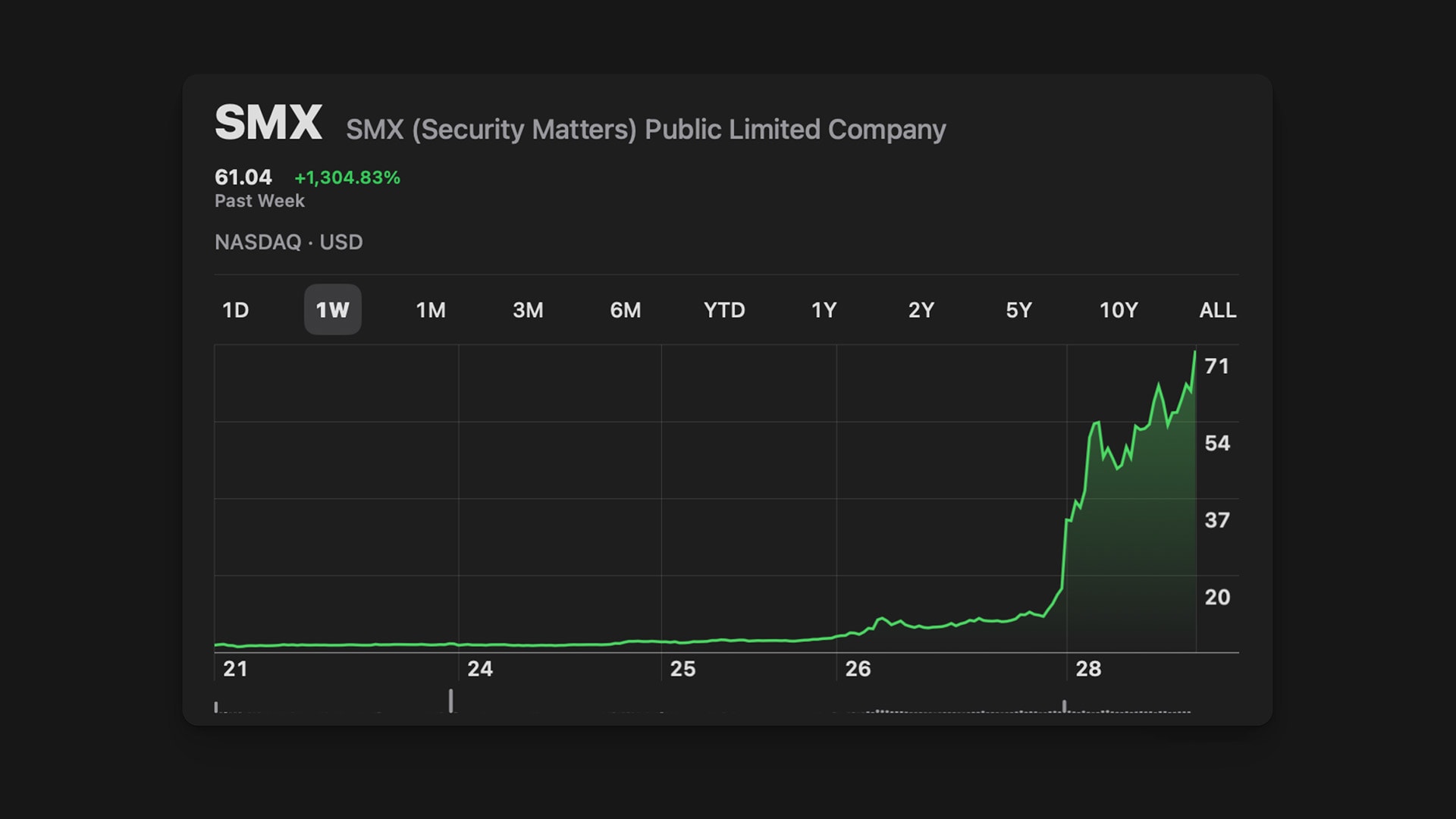
After a sequence of reverse splits that compressed the share structure dramatically, the stock became boxed up, tight in the float, and primed for a disruption. The first consolidation hit on October 23, 2025, when Security Matters Public Limited Company executed a 10.89958:1 reverse stock split. Roughly 15.5 million ordinary shares consolidated into approximately 1 million. Warrants adjusted proportionately. Fractional shares aggregated and sold for cash where possible. The new adjusted identifiers went live immediately under the same ticker, SMX, with updated CUSIP G8267K182 and ISIN IE000UPDVNX9.
Then came the second split on November 18, 2025. The Board approved an 8:1 consolidation reducing outstanding ordinary shares from 8,404,581 to 1,050,572. Again all related securities adjusted proportionately. Again fractional shares aggregated for market sale. The objective remained the same to sharpen stock positioning, streamline shareholder math, and create a structure that could withstand algorithmic pressure rather than be consumed by it.
And then the market did what microcap markets sometimes do. The stock broke the box. It traded from a few dollars to over 60 in the span of days. No apologies for volatility. This is the arena where algorithmic grounding meets human psychology, where tight floats overpower mechanical firepower, and where stocks in survival mode can rewrite their own narrative on the tape.
In the microcap and small-cap world transformative execution is never linear. It is compressed time, compressed structure and compressed disbelief. When the moment hits it hits fast.
The SMX move shows the core reason investors buy these stocks. The chance to be early to something that refuses to behave like the last thing that disappointed them. It is a case study in what happens when a stock gets boxed up.
Technical vs Fundamentals
But the SMX story is a technical mirage. No revenues, no real operations management barely present and nothing behind the structure. A mathematically executed tick where value was artificially created not built. Shorts were drawn into a trap set by tight control of the float and lack of borrow. Technically sharp but fundamentally empty. The emperor has no clothes.
Unlike SMX, our company Creatd Inc. is rooted in the United States. Real company, real jurisdiction, real portfolio and real execution. Our business has revenues operations and a growing asset base. We are building a portfolio, expanding our subsidiaries and acquiring strategically. The strategy is operational not theatrical and the balance sheet is tightening because the work is being done not simulated.
The SMX move demonstrated a trap. The CRTD opportunity demonstrates a structure built by intention around actual assets, actual revenues and an actual plan. Our inflection point will come from execution portfolio growth and market conditions meeting reality not from a vanish trick on the tape. But our inflection point will come, and when it does it will re-define the process.
SMX showed what a boxed-up stock looks like. CRTD will show what a boxed-up company can become when there is a real business inside the structure.
This isn’t a market for the faint of heart. It’s a market for the tightly structured, the underpriced, the statistically improbable and the CEOs and shareholders who get shoved into corners and come out swinging anyway.
And if you were staring at SMX over the last week you saw exactly that an inflection point manufactured by necessity exploited by timing validated by execution and proven by the tape itself.
In the Micro and small cap markets inflection points aren’t occasional, they define the entire journey. Every meaningful change in direction, every pivot in the market, every strategic step forward can become the moment where value is created, or where opportunity slips away.
Shareholders who invest in companies at this stage are not here for slow or incremental progress. They want something that can truly change the game. They want the chance to be part of a company that can multiply in value when execution, strategy, and timing finally line up.
The old idea of the ten bagger still hits home because it speaks to a deeper belief that big returns are possible when a company is operating at the edge of innovation and resilience. At the same time the market has become a different kind of arena. Trading is faster, more technical, and often driven by algorithms that can move stocks in sharp swings irrespective of fundamental value.. These systems have been refined for more than a decade and they can push prices hard in both directions, which often leaves retail investors feeling like they have been personally attacked by dark forces they cannot see.
Shareholder mentalities
In every small-cap company, the shareholder base eventually divides itself into two broad groups. Neither is inherently good or bad, they simply have different philosophies and time horizons.
1. The Short-Term Shareholder
Short-term participants are seeking opportunity in volatility. They buy at a discount and sell into strength, recycling capital into the company again and again. In the earliest stages of corporate development, this can actually help: it provides liquidity, movement, and support while a business is still forming its identity.
But if a company begins to scale, if it enters the race toward profitability then overreliance on short-term recycling becomes dangerous.
If the cycle continues too long, those investors eventually miss the upside, and the company can become trapped in a loop of constant capital replacement rather than true value creation. One too many turns of that wheel can be the difference between taking off and stalling out.
2. The Long-Term Shareholder
The long-term holder is operating from a different set of priorities. They are not betting on volatility; they are betting on leadership, strategy and execution.
They are looking for the moment when the company outruns the short-term mentality entirely. They are waiting for when there is a shift from survival mode to growth mode.
In the entrepreneurial, high-volatility small-cap ecosystem, history shows us something important: very few management teams make it through. Many fall short, often after losing nearly everything in the attempt. But the teams that survive do so because they are willing to rebuild themselves, retrain, re-strategize, and push forward even when the odds seem insurmountable.
Those are the teams long-term shareholders are looking to back.
Not because they expect perfection, but because they believe in resilience.
Where These Two Mindsets Collide
The truth is that both groups can and do exist inside the same stock as they do in CRTD.
The short-term shareholder responds to technical patterns and algorithmic movement, believing the chart is the story.
The long-term shareholder believes the company is the story.
One group trades on volatility.
The other invests in value creation.
Both perspectives shape the market. But ultimately, what carries a company across the finish line is execution not algorithms.
When a company rightsizes its balance sheet, streamlines operations, rebuilds revenue, and redefines its mission, something happens that changes the entire shareholder equation:
Long-term believers begin to outweigh short-term recyclers.
That transition is the inflection point. It is slow at first, then sudden. It’s where transformation stops being theoretical and becomes measurable. And it’s where the future stops being something we hope for,and becomes something we actively build.