The SEC Has Approved Nasdaq's $5 Million Delisting Rule. Here Is What It Does.
CEOBLOC
Published on July 23, 2026

On July 22, 2026, the SEC (Securities and Exchange Commission) approved a new Nasdaq continued-listing standard that changes how quickly the exchange can remove its smallest companies. The proposal had been discussed for the better part of a year. It is now approved. Every company trading near the threshold should understand exactly how it works, because the mechanics are different from the rules that came before it.
What the rule actually says
Under the new standard, Nasdaq can move to delist a company whose Market Value of Listed Securities falls below $5 million for 30 consecutive trading days. Market Value of Listed Securities, often shortened to MVLS, is the market value of the securities Nasdaq has listed for a company. In practice it tracks closely to what most people call market capitalization.
The $5 million figure is not itself new. A version of that threshold has existed for years. What is new is the treatment that follows once a company crosses it.
The rule in plain terms
Here is the whole thing, step by step, with nothing left out.
Every company has a size number. Take the share price and multiply it by the number of shares Nasdaq lists. That total is the company's Market Value of Listed Securities. It is basically how much the company's listed stock is worth all together.
The rule draws a line at $5 million. If that size number sits below $5 million, the company is too small under the new standard.
One bad day does not count. The company has to stay below $5 million for 30 trading days in a row. Thirty market days, back to back.
Then Nasdaq moves to remove it. The company is told it no longer meets the standard.
The long grace period is gone. Companies at this level used to get a cure period, often six months or more, to climb back above the line. Under the new rule, that runway is removed.
There is one narrow chance to appeal. The company can ask a Nasdaq Hearings Panel to reconsider. While that plays out, the stock can trade over the counter.
If the appeal does not work, the company is off Nasdaq. Its shares trade on the over-the-counter market instead of on the exchange.
The short version: stay under $5 million for 30 trading days in a row, and you are out, without the long runway companies used to get.
The part that actually matters
Read those seven steps again, because one of them is doing all the work. It is not the $5 million number. That line, in one form or another, has been on the books for years. It is the fifth step, the one where the grace period disappears.
Until now, a company that fell below the line was handed time. Often six months or more, sometimes extendable, to climb back while keeping its listing. That runway is what the new rule takes away. The threshold is old. The clock is old. What is new is that a company at the bottom no longer gets time to recover, and time is the one thing a small company in trouble actually needs. That is the change with teeth, and it is worth being honest that it is the whole story here. The rest is procedure.
On the record: Nasdaq filed the proposal in January 2026, the SEC took comment and Nasdaq amended it along the way to preserve some Hearings Panel discretion, and the Commission approved it in July 2026. Any company near the line should confirm the exact effective date and transition mechanics against the approved rule text.
Who is affected
By the estimates cited around the approval, roughly 180 Nasdaq-listed companies were trading below the $5 million mark near the time the rule was approved. About one-third of those companies are based in Asia. In its review, the SEC noted that a significant number of microcap companies would have failed the new standard over the years, including on the order of 140 companies that remained below $5 million for 30 consecutive trading days in 2023.
The rule was not adopted without disagreement. Advocates for smaller issuers argued that a faster delisting path can work against small-company capital formation and may create incentives to short-sell companies near the line. Several large market participants supported the change on the view that it raises the quality and liquidity floor of the exchange. Both positions are now part of the public record.
How the rest of the market compares
Nasdaq is not the only exchange revisiting its treatment of the smallest listed companies. NYSE American, the exchange most comparable to the Nasdaq Capital Market for microcap issuers, has proposed a parallel standard built around a $5 million market-capitalization floor measured as a 30-trading-day average. That proposal was still working through the review process and had not received final approval as of this writing. The New York Stock Exchange itself already applies a higher bar: a company whose average global market capitalization falls below $15 million over 30 consecutive trading days is subject to immediate delisting, with no cure period. That standard is long-standing.
What it means in practice
For a company trading near the bottom of the range, three points are worth internalizing. First, the relevant test is a 30-consecutive-trading-day measurement, not a single bad session. Second, there is no longer a long compliance window to rely on at this threshold. Third, the appeal that remains is narrow. The practical consequence is that market value at these levels has to be managed as a continued-listing requirement in its own right, not treated as a number that only matters at the initial listing.
What the rule does not fix
I have made this argument for some time, and the approval of this rule does not change it. Removing a company from the bottom of the market does not remove the bottom of the market. It changes which company occupies it.
The threshold is a line. When one company falls below it and is delisted, another moves down to take its place. The line does not clear the field. It cycles it.
The companies that live near that line tend to be caught in the same trap. A small company under pressure raises capital on difficult terms. That financing dilutes the stock. The dilution pushes the market value lower. The lower market value forces the next raise on terms worse than the last. That is the loop. It is a funding cycle that feeds on itself, and it is the real reason so many small companies sit where they sit.
A faster delisting rule acts on the symptom of that loop, a low market value, rather than its cause, which is how these companies are financed. Delisting the company at the bottom does nothing to break the cycle. It hands the bottom to the next company in line, and the cycle begins again.
If the goal is a healthier market for small companies, the harder and more useful work is on the financing structures that keep them underwater in the first place. Raising the floor and sweeping out whoever is standing on it are not the same thing. One repairs a market. The other only rearranges it.
The only real way out is M&A
That is the systemic answer, and it will take years. A company sitting on this list today does not have years. For the company itself, there is only one move that changes its own math, and it is mergers and acquisitions.
Look at what the other options actually are. A company can raise more money, but raising money on these terms is the cycle. A company can wait for the market to turn, but the new rule just took the waiting room away. Neither path changes the size of the business underneath the stock. They only change how long it takes to arrive at the same place.
Combination changes the size of the business. Two sub-scale companies that merge do not simply add their market values together. They share a cost structure, they combine revenue, they stand on one real balance sheet instead of two thin ones, and they reach a market value that clears the threshold because the company underneath it is genuinely bigger. That is a number the rule cannot easily erase, because it is built on scale rather than on the next financing.
This is not a rescue of last resort. It is the rational response to the incentives the rule creates. When the penalty for staying small becomes immediate, the premium on getting bigger, quickly and structurally, goes up with it. For hundreds of companies sitting near the line, another financing buys a few months. A merger buys a future. You cannot finance your way out of being too small. At this point, you can only combine your way out.
Why the list runs to $7 million, not $5 million
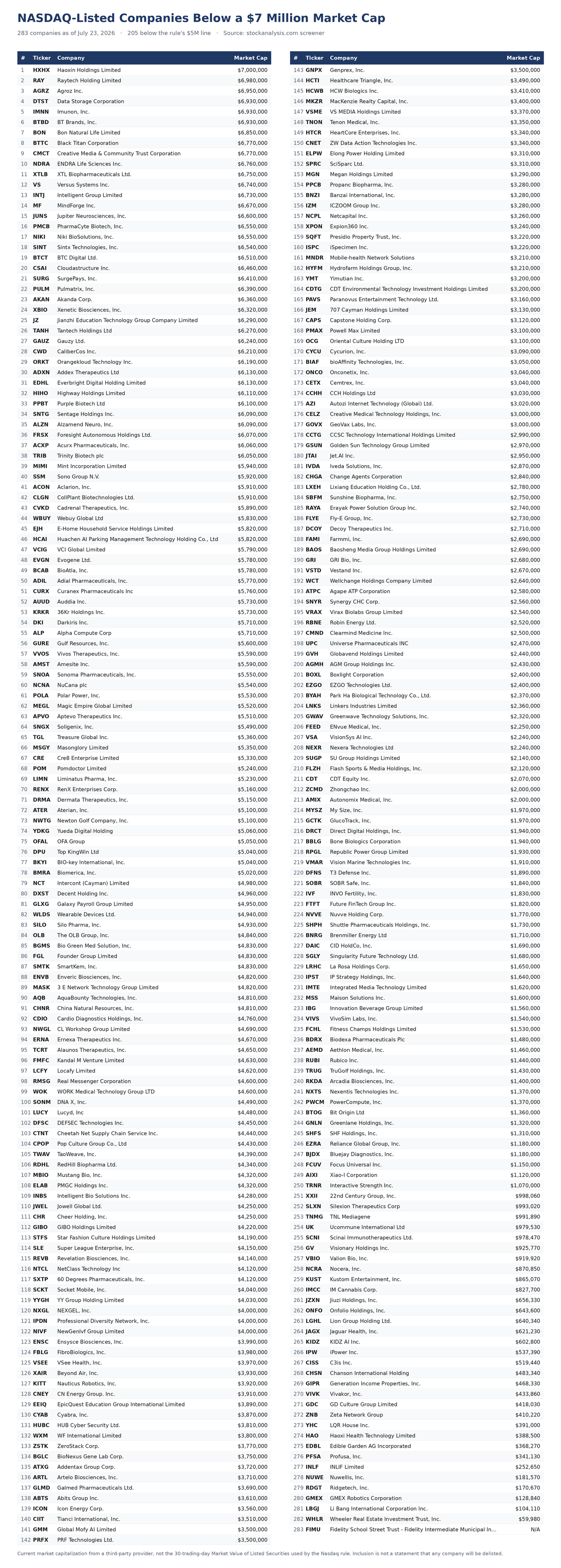
The list that follows shows every company that was trading below a $7 million market capitalization as of July 23, 2026. The cut is set at $7 million on purpose, two million dollars above the rule's $5 million line, and the reason goes to the heart of everything above. The rule measures market value over 30 consecutive trading days. A company sitting a little over $5 million today can slip under the line and start that clock after an ordinary decline. The companies between $5 million and $7 million are the on-deck group. They are the ones most likely to fall into the standard next.
This is the cycle made visible on a single page. When a company at the bottom is delisted, one of these is the company that moves down to take its place. The line does not empty. It refills.
Of the 283 companies shown, 205 were below the rule's $5 million line. The rest sit just above it, on the wrong side of a 30-day clock. That is why the list does not stop at $5 million. The companies just over the line are not safe. They are next.
Appendix: NASDAQ-listed companies trading below a $7 million market capitalization
Source: stockanalysis.com stock screener, filtered to Exchange = NASDAQ and market capitalization below $7,000,000. Data as of July 23, 2026. 283 securities, sorted from highest to lowest market capitalization. Figures are current market capitalization from a third-party data provider and have not been independently verified. This is not the 30-trading-day Market Value of Listed Securities that the Nasdaq rule uses, and inclusion here is not a statement that any company has failed, or will fail, a continued-listing standard.