Where the Real Power Sits: A History of the Modern Market Pyramid
Jeremy Frommer
Published on December 10, 2025
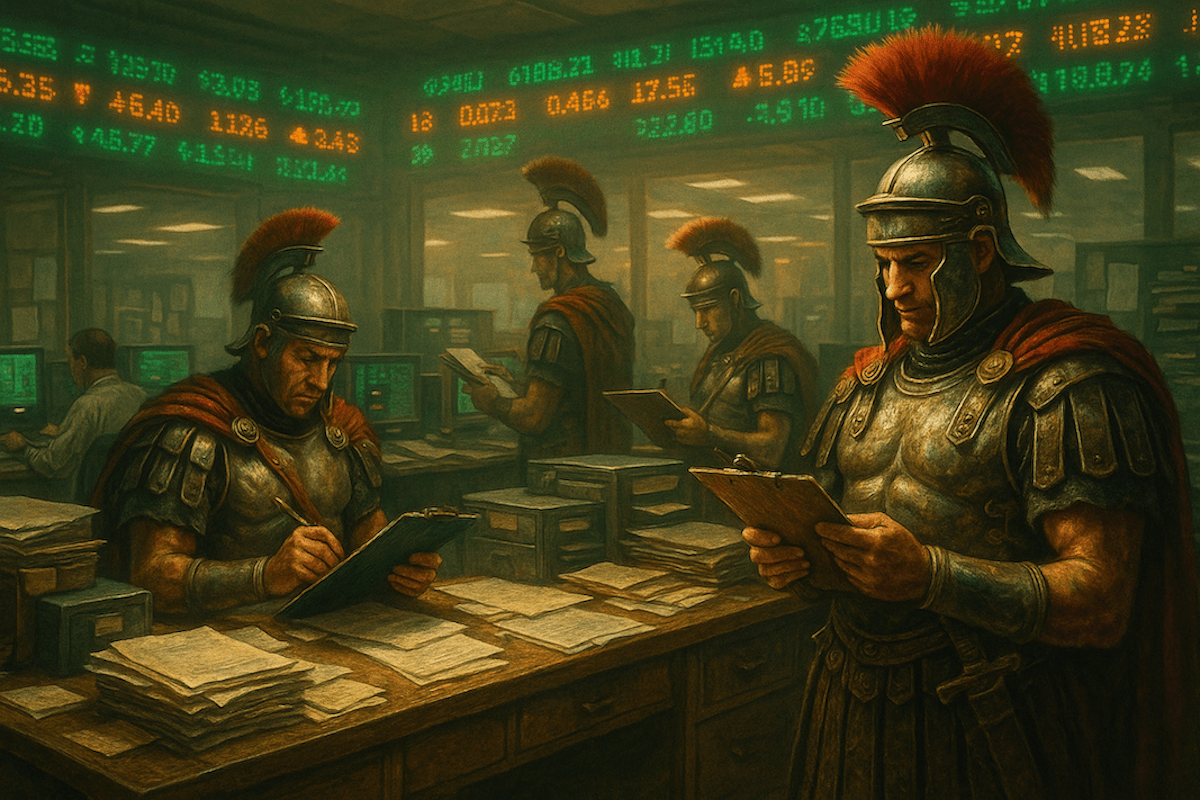
If you’ve been in this business long enough, truly in it, not commenting from the bleachers you eventually learn the truth that power on Wall Street never belonged to the loudest players. It belonged to the quietest rooms.
And those rooms weren’t trading floors. They were back offices.
People today talk about Citadel, Virtu, Jane Street as if these were inevitable creations of modern finance. But the oligarchs didn’t materialize because someone wrote clever algorithms. They materialized because, long before the public noticed, the plumbing of Wall Street consolidated into a handful of houses that understood what was coming.
I watched it happen.
Up close.
This was the 1990s, the moment when the “family firm” culture of Wall Street, which still resembled something between a Roman senate and a New York crime family, collided with the first wave of real financial technology. Back offices were upgrading themselves faster than compliance departments could understand what they were even looking at.
Then came day-trading technology, followed by institutional automation and soon by the routing wars. And somewhere inside that chaos, the power shifted.
I know because I was part of that evolution. As CEO of Carlin Financial, I had a front-row seat to the merging of those worlds and the rise of electronic liquidity, the early microstructure battles, the first algorithms that would go on to define an entire era. By the time I sold Carlin to RBC in 2008, the Flash Boys world was already forming. Michael Lewis exaggerated my character, yes, but the atmosphere he described was real: we were watching the guard change in real time.
But here’s what Lewis didn’t touch:
The guard didn’t just change, it consolidated. And consolidation always starts with the plumbing.
GOLDMAN, JPMORGAN, AND THE INVENTION OF MODERN POWER
Two acquisitions shaped the next twenty years more than any IPO, any ETF, any “innovation” CNBC drooled over.
Goldman buys SLK
People think Goldman bought Spear, Leeds & Kellogg for market making.
No.
They bought REDI, the front-end routing system that would become the operating system of half of Wall Street.
That single acquisition quietly turned Goldman into the most prestigious prime broker on the street, the strongest stock-loan operation in the world, and the back-office empire everyone else had to build around.
JPMorgan absorbs Bear Stearns’ prime business
Bear collapsed. The only trophies left on the table were its prime brokerage, stock-loan book, and infrastructure. And JPMorgan took it.
Overnight, they became the second titan of the new regime.
Everything that followed, including Citadel, Virtu, the wholesale dominance, the microstructure wars, grew on top of these two foundational plumbing empires.
While CNBC told stories about “disruption,” the real disruption had already happened years earlier, in rooms very few people had access to.
THE MEN WHO WOULD BECOME OLIGARCHS
Before Citadel and Virtu were “institutions,” they were men. And I crossed paths with two of them before they ascended the mountain.
Ken Griffin: Citadel’s Sovereign Architect
Ken and I share a link through Frank Meyer of Glenwood, one of the original quant forefathers, whose influence shaped each of us in different ways. Through Frank, I was aware of Griffin long before Citadel grew into the state-within-a-state it represents today, and even then it was clear that Citadel occupied a different place in the market. People call it a market maker, yet its reach extends far beyond that description, functioning with the authority and presence of a nation. It governs liquidity, applies its own form of taxation through the way it handles order flow, and influences the underlying mechanics of how stocks trade across the system. Even in its earliest stage, there was an energy around Citadel that signaled what it was becoming. The firm felt less like a participant in the market and more like a force preparing to reshape the environment around it.
Vinnie Viola: The Warrior Who Built Virtu
I crossed paths with Vinnie Viola more than a few times in the day-trading era. You meet a lot of people in this business, but some of them you remember. Viola was one of them. West Point discipline, battlefield mentality, and an instinct for structure that most people didn’t develop until years later.
Before anyone used the term “HFT,” he understood the truth:
If you control the microstructure, you control the entire game.
Virtu became the embodiment of that philosophy, and worked years without a losing day. His profitability was engineered through design, not luck.
Looking back, it’s obvious: Citadel and Virtu had oligarchic characteristics long before anyone would have dared call them oligarchs.
THE MODERN PYRAMID: WHERE THE POWER ACTUALLY SITS
People like to picture a competitive landscape filled with dozens of firms battling for position, some scrappy and some powerful, all sharing the same arena. That version of Wall Street has been gone for a long time. The market structure that exists today resembles a pyramid, with the peak controlled by two empires that set the conditions everyone else must operate within. Everything beneath that peak follows patterns shaped by their influence, a kind of downstream behavior that reflects the concentration of power at the top.
TIER I — THE OLIGARCHS (Absolute Power)
1. Citadel Securities
Think of Citadel as the central bank of retail order flow.
They don’t “make markets” in the traditional sense. They govern the conditions under which markets function. Fines come, inquiries go, nothing actually slows them. Citadel isn’t reacting to the market; the market reacts to Citadel, and it sets the terms of competition.
2. Virtu Financial
Virtu is the other half of the duopoly.
Their model is about dominance through probability. They built a system where losing days are statistical outliers. Transparency complaints surface from time to time, but Virtu is designed to glide above the turbulence.
Virtu forecasts the market, prices it, and arbitrages the space around it.
Together with Citadel, these two firms form the gravitational center of the financial world. Everyone else orbits them.
TIER II: THE INTELLECTUAL SUPERPOWERS
3. Jane Street
The monks of probabilistic finance.
They extract insight and signal, and avoid noise. They rarely speak, rarely miss, and rarely lose. Their existence alone changes how ETFs behave.
4. Susquehanna (SIG)
Built on poker theory and an almost academic understanding of risk.
To this day, they are one of the most disciplined shops on Earth. Nothing flashy, but deeply influential.
5. Two Sigma Securities
The quant cathedral.
Everything is math, rigor, and refinement. They don’t dominate flow like the oligarchs, but their intellectual footprint is enormous. These are the thinkers. They move quieter, but when they move, the surface ripples.
TIER III: THE STRONGHOLD FIRMS
IMC
Wolverine
Hudson River Trading
Strong firms. Advanced technology. Real talent.
But they’re still playing on a field shaped by the Tier I houses. The profitability is there, but the power, the ability to set the rules, is not. They’re operating within the structure rather than defining it.
TIER IV: THE SCRAPPERS
G1 Execution (Knight’s descendant)
Flow Traders
They serve a purpose. They fill liquidity gaps. They take risk when the bigger houses briefly step aside. They’re necessary pieces of the ecosystem, but they no longer define it. Their era of influence ended when the Flash Boys era gave way to the oligarch era.
THE TAKEAWAY: WHY MICROCAPS GET HUNTED
This pyramid isn’t natural, nor did it evolve because of competition.
It evolved because of infrastructure consolidation: the slow, quiet merging of routing systems, stock-loan books, market-making exemptions, and the technology that eventually embedded these firms at the center of everything.
The hunting of microcaps is structural.
Microcaps live and die by:
size-tier quoting rules
sub-dollar share penalties
liquidity thresholds that punish weakness
spread mechanics that widen under pressure
psychological breakpoints
CEOs who don’t understand their own battlefield
None of this is about fundamentals. It’s about mechanics.
And here’s the part most CEOs miss:
The same structure that suppresses a microcap can also launch it.
When supply is tight…
When shareholders are disciplined…
When floats aren’t diluted into oblivion…
When demand overwhelms the forced-sizing behavior of the market makers…
The whole dynamic flips. The oligarchs’ advantage becomes their constraint. Their algorithms stop leaning into falling knives and instead step back, because the math changes once a stock crosses critical price tiers and supply dries up.
In other words, the machine that hunts you can also propel you, if you design the conditions correctly. That’s the real lesson: not that the markets are rigged (they are).
But that the rigging has pressure points, and pressure points can be used.