The Market Maker Sizing Trap and the Coming Collapse of Algorithmic Short Dominance
Jeremy Frommer
Published on December 8, 2025
There is a hidden system underneath microcap trading that most retail investors do not understand. It has nothing to do with fundamentals. It has nothing to do with news. It has everything to do with structure. And structure, once understood, does not lie. It exposes how the game is actually played, who benefits, and why certain companies get crushed while others, with the right strategy, can break out and never go back.
This is the third article in a series about SMX and the broader microcap landscape. The first explored the inflection point created by a reverse split. The second highlighted why float matters more than share count. This third piece reveals the most important structural mechanism of all that both inflicts pain and can lead to salvation for a public stock. The rules governing the required quote sizes for market makers at different price tiers. Once you understand these rules, the entire microcap ecosystem suddenly makes sense. The manipulation. The collapses. The short dominance. The rare squeezes. The inflection levels. Everything.
The market is not psychological. The market is mechanical.
And if you understand the machine, you can beat it.
The Real Reason 50 Cents and 1 Dollar Matter
Investors believe that round-number levels like fifty cents or one dollar matter because people attach psychological meaning to them. But these levels matter for a completely different reason. They are structural breakpoints in the market-making rulebook.
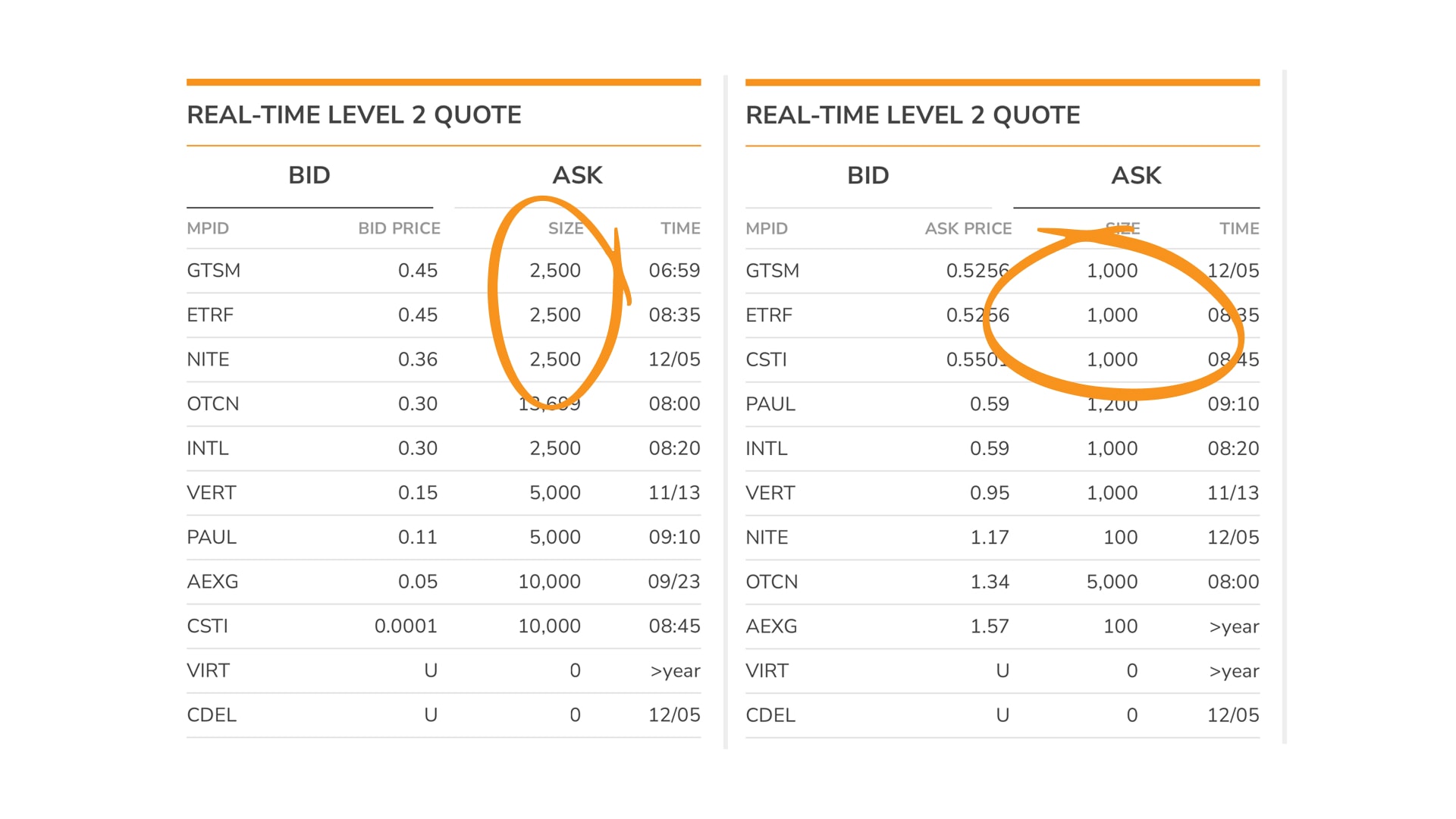
Under FINRA Rule 6433, market makers must display minimum quote sizes that change based on the current price of a stock. These are not guidelines. They are obligations. When a stock trades under ten cents, a market maker must show ten thousand shares. Between ten and twenty cents, five thousand shares. Between twenty cents and fifty cents, twenty five hundred shares. Over fifty cents, one thousand shares. Over one dollar, one hundred shares.
Every algorithm in the microcap space is programmed around these price tiers. Every predatory short strategy depends on them. Every forced collapse is built on the same playbook. As the stock trades lower, the required liquidity increases dramatically. This gives the algorithm more ammunition. More visible size to lean on. More supply to work with. Forced liquidity becomes a weapon that accelerates the decline.
This is why low-priced stocks fall harder and faster than high-priced ones. It is not because the company is worse. It is because the rulebook gives the market maker and the algorithm more firepower.
The system is designed backward. It punishes weakness and rewards strength. Once a stock climbs above the key tiers, especially one dollar, the required size vanishes. The liquidity on the offer evaporates. The algorithm loses its cushion. The stock can rise faster because the structure no longer suppresses it.
This is not psychology. It is mathematical architecture.
Why Market Makers Prefer Penny Stocks Over High-Priced Names
There is another element that makes the microcap space a paradise for market makers. It is easier for them to make money in a ten-cent stock than in a ten-dollar stock. Easier by orders of magnitude. The economics are simple. In low-priced stocks they can churn tens of thousands of shares for tenths of a cent. Retail sees pennies. Market makers see millions of shares. Millions of opportunities. Deep volume created by regulatory sizing requirements. Mechanical liquidity they can exploit.
In a high-priced stock, a market maker may only be flipping one hundred shares. The economics are weak. The spread is thin. The retail behavior is calmer. The narratives are more mature. The manipulation is harder. The risk is higher. The upside is lower.
In a ten-cent stock, the dynamics flip. The spread is wider. The tick is more meaningful. The retail investor is more emotional. The rules force size into the book. The market maker has enormous freedom to push the stock wherever the algorithm wants it. It is the perfect playground.
This is why microcaps get abused. It has nothing to do with the companies. It has everything to do with the structural profitability of exploiting them.
The Retail Trap: How Trading Platforms Handicap Individual Investors
While market makers enjoy total freedom to churn massive size, retail investors face restrictions that are rarely discussed.
Platforms like Interactive Brokers, Schwab, Fidelity, and TD Ameritrade impose strict rules:
• Buying under certain prices is blocked
• Shorting is allowed for market makers but not for retail
• Margin is restricted or eliminated entirely under certain price levels
• Lockout periods occur during volatility
• Pattern-day-trader rules suppress active trading
• Certain order types are disabled
• Market orders turn into hidden traps against algos
Retail is forced to play slow while market makers play fast. Retail is forced to play small while market makers play large. Retail is forced to trade blind while market makers see the entire book. It is not a fair system. It was never designed to be one. The microcap market exists as an ecosystem for algorithms to feed on unsophisticated participants.
The irony is that this predatory environment only works when stocks remain in the lower-tier pricing zones. Once a stock rises above those zones, the ecosystem breaks down.
The Companies Behind the Curtain: Who Actually Dominates Microcap Trading
A handful of market makers dominate the penny-stock and microcap world.
Among the most influential are:
• Citadel Securities
• Virtu Financial
• G1 Execution Services
• Jane Street
• Two Sigma Securities
• Cantor Fitzgerald
• Wolverine
• Susquehanna (SIG)
• Hudson River Trading
• Cohen Capital
These firms operate at a speed and scale that retail cannot comprehend. Their algorithms scan every microcap tick, every quote change, every imbalance. They do not need to conduct research. They do not care about fundamentals. They exploit structure. They exploit forced liquidity. They exploit the predictable behavior of retail investors who panic on collapses and chase on breakouts.
The biggest misconception in the microcap world is that market makers provide liquidity. They do not. They provide friction. They provide resistance. They profit from disorder and volatility, not stability.
Their dominance ends only when a company escapes the structural environment where their algos hold power.
The Psychology Shift: Why Price Levels Change Investor Identity
A fascinating transformation takes place when a stock climbs out of the low-price ecosystem. An investor holding SMX at four dollars had one mindset. When that stock hit four hundred dollars after the reverse split, something happened internally. His view of himself as an investor changed. His view of the company changed. His tolerance for risk changed. His willingness to hold long term changed. His sense of ownership increased. He began acting like a participant in a real business, not a short-term gambler.
This transformation breaks algorithmic feedback loops. Algorithms rely on predictable retail panic. They rely on volatility in a low-priced environment. They rely on weak hands. They rely on fear. But investors do not behave the same way at higher prices. They hold tighter. They sell slower. They think more strategically. This creates stability. Stability breaks the algo.
This is the psychological counterpart to the structural shift in the quote sizes. Price changes behavior. Behavior changes structure. Structure changes trading. Trading changes everything.
The Path to Breaking the Algorithmic Regime
When a CEO of a public company understands these mechanics, the game changes. A tight float becomes a weapon. A reverse split becomes an inflection point. A disciplined shareholder base becomes a fortress. A clear narrative becomes fuel. Combining these elements creates a structural trap for the algorithm.
The CEO must:
• Maintain a tight float
• Avoid unnecessary dilution
• Build long-term shareholders
• Create catalysts
• Understand how price tiers affect market-maker behavior
• Push the stock into higher structural zones where the algos cannot function
If a company can push itself through fifty cents, then through one dollar, then through stabilized higher levels, the entire ecosystem shifts. The forced liquidity disappears. The market maker loses his advantage. The algos disengage. They move on to richer environments.
What is left behind is an actual market. Real investors. Real price discovery. Real valuation. Real momentum. The company escapes the gravitational pull of the penny ecosystem. Most will never return.
The Future: Why This Era of Microcap Manipulation Is Ending
We are entering a new chapter in the microcap world. The era of predatory algorithmic control is ending not because regulators are stepping in. They are not. It is ending because CEOs have begun to understand the structure. And once you understand the structure, you can reshape it.
The companies that survive this period will look nothing like the companies of the past. They will be smarter about their float. Smarter about their capital structure. Smarter about how they engage their shareholders. Smarter about how they interact with exchanges. Smarter about breaking through the structural levels that allow manipulation to thrive.
This is the revolution that is coming. Not regulatory. Structural.
The market always changes when structure changes.
We are watching that change in real time.